The Industrial Standard: Why 2-Piece Ball Valves Remain the Go-To Choice Worldwide
In the vast and complex world of flow control systems, 2-piece ball valves have carved a dominant position across multiple industries—from Oil & Gas and Chemical Processing to Water Treatment, Power Generation, and general industrial pipelines. Their popularity is not accidental; it is rooted in decades of proven performance, ease of maintenance, cost-efficiency, and a versatile design that adapts seamlessly to a wide range of pressures, temperatures, and media types.
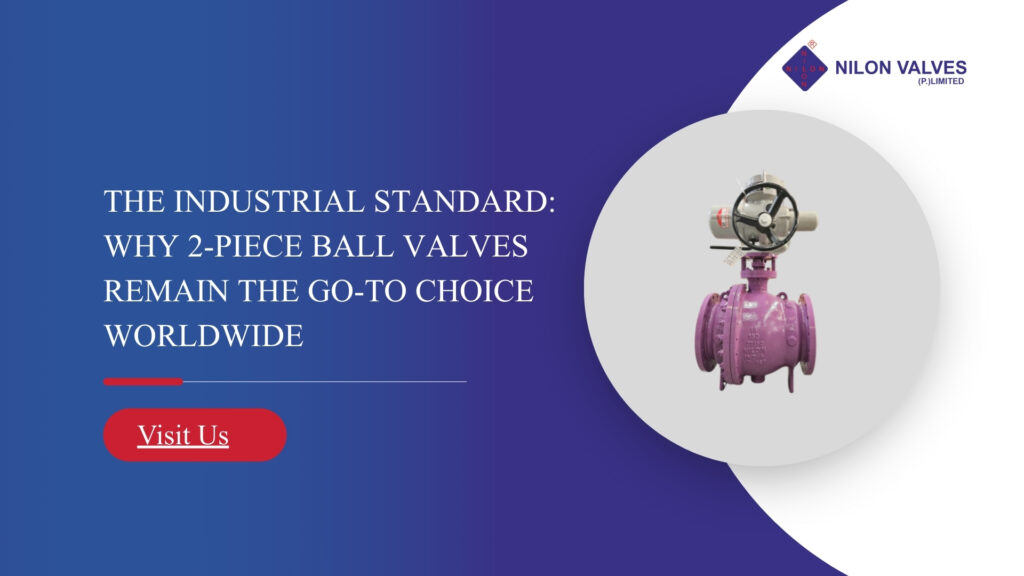
Today, as industries demand safer, more reliable, and more efficient pipeline systems, the role of 2-piece ball valves has become even more significant. This blog explores the many reasons behind their widespread adoption and why they continue to be the preferred choice for engineers, plant managers, and process designers across the globe.
1. Understanding 2-Piece Ball Valves: Structure and Function
A 2-piece ball valve consists of two main body components that house a freely rotating spherical ball with a central bore. When the handle or actuator rotates the ball 90°, the bore aligns with the pipeline for a full, unobstructed flow. In the closed position, the ball blocks the passage, ensuring zero leakage when properly sealed.
Key Components:
- Valve body (2 pieces)
- Ball with precision-drilled bore
- Stem and seat rings (PTFE or high-performance materials)
Why the 2-Piece Design Matters
The simple yet robust two-part construction strikes the perfect balance between:
- Structural integrity
- Ease of assembly
- Low manufacturing cost
- High flow efficiency
2. Versatility across Industries
One of the biggest advantages of 2-piece ball valves is their adaptability. They are suitable for handling:
- Liquids
- Gases
- Slurries
- Corrosive chemicals
- High-purity fluids
Used Widely In:
- Oil & Gas pipelines and refineries
- Chemical and petrochemical industries
- Water treatment and distribution systems
- HVAC and fire protection
3. High Flow Capacity with Minimal Pressure Drop
The full-bore construction of most 2-piece ball valves ensures that the flow remains almost unrestricted when the valve is open. This characteristic is especially important for:
- Long-distance pipelines
- High-flow industrial systems
- Pumps and compressors that rely on minimal pressure resistance
Benefits of Low Pressure Drop
- Reduced energy consumption
- Longer equipment lifespan
- Enhanced operational efficiency
4. High Flow Capacity with Minimal Pressure Drop
The full-bore construction of most 2-piece ball valves ensures that the flow remains almost unrestricted when the valve is open. This characteristic is especially important for:
- Long-distance pipelines
- High-flow industrial systems
- Pumps and compressors that rely on minimal pressure resistance
Benefits of Low Pressure Drop
- Reduced energy consumption
- Longer equipment lifespan
- Enhanced operational efficiency
5. High Flow Capacity with Minimal Pressure Drop
The full-bore construction of most 2-piece ball valves ensures that the flow remains almost unrestricted when the valve is open. This characteristic is especially important for:
- Long-distance pipelines
- High-flow industrial systems
- Pumps and compressors that rely on minimal pressure resistance
Benefits of Low Pressure Drop
- Reduced energy consumption
- Longer equipment lifespan
- Enhanced operational efficiency
6. Cost-Effective Without Compromising Performance
Cost is always a major consideration in large industrial installations. Whether a project includes 50 valves or 5,000 valves, the choice affects both the initial investment and long-term operating expenses.
Why They Offer Better Cost Efficiency:
- Simple construction lowers production costs
- Requires fewer parts than 3-piece valves
- Lower assembly and testing costs
- Reduced maintenance expenses
- High durability reduces replacement frequency
Also Read: Why Ball Valves Remain the Backbone of Modern Flow Control Systems
7. Suitable for Manual and Automated Control
Industries are rapidly shifting toward automated flow control systems for better accuracy, safety, and process optimization. 2-piece ball valves are well-suited for both manual and automated configurations.
Compatible Automation Options:
- Pneumatic actuators
- Electric actuators
- Hydraulic actuators
Their quarter-turn operation makes them ideal for automation because:
- They require less torque
- They have simple open/close mechanics
- They provide faster response times
8. Excellent Resistance to Corrosion and Harsh Environments
Industrial environments are often exposed to chemicals, moisture, heat, or physical stress. 2-piece ball valves are available in materials that resist these challenges, such as:
- CF8/CF8M stainless steel (SS 304/316 equivalents)
- Carbon steel with corrosion-resistant coatings
- Duplex and super duplex stainless steel
With proper selection, 2-piece ball valves can withstand:
- High chloride levels
- Acidic or alkaline chemicals
- High-temperature steam
This adaptability adds to their global dominance.
9. High Durability and Long Service Life
A major advantage of 2-piece ball valves is their robustness. The solid body construction, high-quality machining, and wear-resistant seats ensure that these valves can handle repeated operations under tough conditions.
Durability Highlights:
- Low friction operation
- Resistant to thermal expansion
- Withstand high cycle frequency
- Retain sealing integrity over long periods
10. Compliance with International Standards
Modern industries require valves that comply with strict international standards for quality, performance, and safety. 2-piece ball valves are typically designed and manufactured in accordance with:
- API 608 / API 6D
- ASME B16.34
- ISO 5211 (Actuator mounting)
- Fire-safe certifications (API 607 / ISO 10497)
- Pressure Equipment Directive (PED)
11. Why 2-Piece Ball Valves Continue to Lead the Market
After decades of continuous engineering improvements, the 2-piece ball valve remains unmatched in several key areas:
What Makes Them the Go-To Choice Worldwide?
- Optimal balance between cost and performance
- Tight sealing and reliable shutoff
- Quick and easy operation
- Adaptability to multiple industries
- Compatibility with automation technologies
- Durable construction that thrives in harsh environments
Also check out: Industrial Valve Manufacturer & Exporter USA
Conclusion
The global reliance on 2-piece ball valves is not merely a trend—it is a reflection of their proven engineering, reliability, performance, and long-term cost efficiency. From Oil & Gas installations and chemical processing plants to municipal water pipelines and industrial manufacturing units, these valves continue to provide seamless flow control with minimal maintenance.