Understanding Globe Valves: Design, Function, and Industrial Applications
In the world of industrial flow control, globe valves hold a critical position. Recognized for their ability to precisely regulate flow, they are a preferred choice in industries where accuracy and reliability are paramount. From power plants to chemical processing and water treatment facilities, globe valves ensure smooth, safe, and efficient operation of systems handling gases, liquids, or steam.
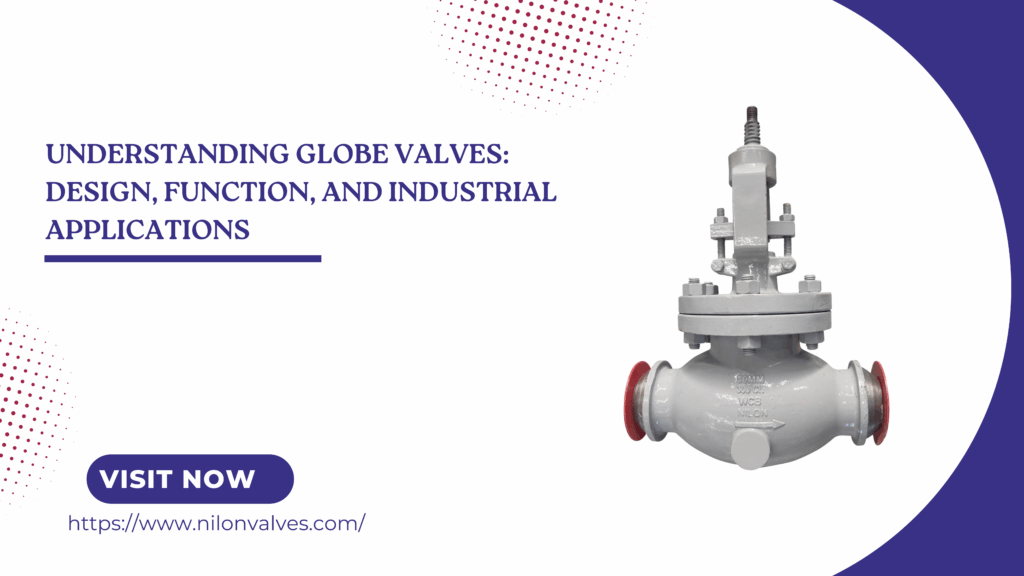
1. What Is a Globe Valve?
A globe valve is a type of valve used to start, stop, and regulate fluid flow within a pipeline. Unlike gate or ball valves, which are typically designed for on/off control, globe valves excel in throttling applications — allowing operators to finely adjust flow rates.
The name “globe” originates from the valve’s spherical body shape (in early designs). Modern designs may differ in shape, but the term persists due to its association with flow control characteristics.
Key Characteristics
- Provides excellent flow regulation.
- Offers tight shut-off capability.
- Suitable for both manual and actuated operation.
- Commonly used for high-pressure and high-temperature applications.
2. Construction and Components of a Globe Valve
A globe valve consists of several key parts, each contributing to its precise control and durability.
Main Components
- Body – The main pressure-retaining structure that houses internal parts.
- Bonnet – Covers the body and provides access to the internal components for maintenance.
- Stem – Connects the handwheel or actuator to the disc and transmits motion.
- Disc (Plug) – The moving component that throttles or blocks flow.
- Seat – Provides a sealing surface for the disc.
- Handwheel or Actuator – Enables manual or automated operation.
- Packing & Gland – Prevents leakage around the stem.
Design Variations
The internal flow path is what makes a globe valve unique. The disc moves perpendicular to the seat, allowing for precise control of fluid flow. The body design may vary to optimize flow characteristics or ease of maintenance.
3. How Does a Globe Valve Work?
The operation of a globe valve is relatively simple yet highly effective.
- When the hand wheel or actuator is turned counter clockwise, the stem lifts the disc away from the seat, allowing flow.
- Turning it clockwise lowers the disc, restricting or stopping flow.
- Intermediate positions enable flow throttling, making globe valves ideal for regulating pressure and flow rates.
Because of their design, globe valves have a linear flow characteristic — meaning the flow rate changes proportionally with stem movement. This allows for more accurate flow adjustments than most other valve types.
4. Types of Globe Valves
Globe valves come in several configurations to suit different pipeline layouts and performance needs. The three most common designs include:
a) Z-Type (Tee Pattern) Globe Valve
The most common design, featuring a horizontal seat and vertical stem.
Advantages: Excellent throttling control and easy maintenance.
Applications: General-purpose flow control in process systems.
b) Y-Type Globe Valve
The seat and stem are angled (usually at 45°) to reduce flow resistance.
Advantages: Lower pressure drop and higher flow efficiency.
Applications: High-pressure and high-temperature services.
c) Angle Pattern Globe Valve
The inlet and outlet are positioned at a 90° angle.
Advantages: Eliminates the need for additional elbows, saving space and cost.
Applications: Pulsating flow systems, where changes in flow direction are needed.
5. Advantages of Globe Valves
Globe valves are widely used because of their impressive performance advantages:
- Excellent Flow Control:
The design allows precise throttling of flow and pressure regulation. - Good Shut-Off Capability:
When fully closed, the disc and seat form a tight seal, minimizing leakage. - Durability:
Capable of handling high pressure and temperature conditions for extended periods. - Versatility:
Suitable for both manual and automated control with pneumatic or electric actuators.
6. Limitations of Globe Valves
Despite their benefits, globe valves also have some limitations:
- Higher Pressure Drop: Due to their internal flow path, they create more resistance compared to gate or ball valves.
- Cost: Typically more expensive than simpler valve types.
- Weight: Heavier and larger for the same nominal size.
8. Industrial Applications of Globe Valves
Globe valves are used across numerous industries where flow regulation and throttling are essential. Common applications include:

a) Power Generation
Used in steam lines, cooling systems, and feedwater control due to their ability to handle high pressure and temperature.
b) Oil & Gas Industry
Employed in refining, petrochemical processing, and pipeline systems for flow and pressure control.
c) Chemical Processing
Ideal for handling corrosive and hazardous fluids with precise regulation.
d) Water Treatment Plants
Used in regulating water flow, chemical dosing, and filtration systems.
3) Pharmaceutical and Food Industries
Stainless steel globe valves ensure hygienic and accurate flow control
9. How to Choose the Right Globe Valve
Selecting the right globe valve requires evaluating several factors:
- Media Type:
Determine if the fluid is gas, liquid, steam, or corrosive. - Pressure and Temperature:
Choose materials and design rated for your system’s operating conditions. - Flow Rate Requirements:
Consider Cv (flow coefficient) and throttling precision. - Valve Size and End Connections:
Match to pipeline size and connection type (flanged, threaded, welded). - Operation Type:
Manual, electric, or pneumatic actuation. - Maintenance Access:
Choose a design that allows easy servicing in your setup.
10. Modern Trends and Innovations in Globe Valves
Advancements in design and materials are continually improving the performance of globe valves. Some notable innovations include:
- Smart Actuators: Integration of IoT-enabled actuators for real-time monitoring and control.
- Low-Emission Packing Designs: To reduce fugitive emissions and meet environmental regulations.
- Severe-Service Globe Valves: Built for abrasive, high-pressure, or high-temperature conditions.
- Advanced Alloys and Coatings: Extending lifespan in corrosive environments.
Companies like Nilon Valves, a leading industrial valve manufacturer in India, are constantly upgrading their product lines to meet global performance and safety standards. Their globe valves are engineered for precision, durability, and reliability, serving industries ranging from oil & gas to water management.
11. Maintenance Tips for Globe Valves
To ensure long service life and reliable performance:
- Regularly inspect seats and discs for wear.
- Check stem packing for leakage and replace when necessary.
- Lubricate moving parts periodically.
- Operate the valve through its full range to prevent seizing.
- Always install with correct flow direction as indicated on the body.
Conclusion
Globe valves remain a cornerstone of industrial flow control, combining precision, durability, and adaptability in one design. Their superior throttling capability makes them indispensable in systems where accurate flow regulation is critical — from energy generation to chemical processing and water treatment.
Also Visit: Why Sustainable Valves Are the Future of Oil, Gas, and Water Industries